The survey my group and I created on Google Docs about research into our chosen genre of indie-rock:
This survey created on Google Docs, asks the recipients their demographic, interests, and what they expect to see from an indie-rock video, CD cover, and album advertisement.
As our group sent it to people in our year group, we expect the gender demographic to be varied, while the age demographic is predicted to be between 17-19, with a few being 24+, due to sending it to teachers, in order to see their opinions from a different age range. We hope that recipients will describe in detail their expectations of a music video, CD cover, and advertisement, as this will help us when it comes to analysis of the research, and also when making our music video. Their replies will inform us of what people want from this genre, enabling us to include this in our video, so that it is conventional and appropriate for the genre.
Tuesday, 25 September 2012

Monday, 24 September 2012
Advertisement Research
'Sigh No More' - Mumford and Sons:

'X & Y' - Coldplay:

'To Lose My Life...' - White Lies:

Conventions seen throughout the genre:
- Dark colours are included, with stark colours contrasts.
- The band name and album title are displayed in bold letters, that stand out amongst the background.
- Either an image of the band, or the album artwork is the central focus of an advertisement.
- Record labels are credited at the bottom of the advert, as part of the promotion.
- Further information about the band and their songs are given; part of the track list is provided, the release date for the CD is given, and their website is shown.
- Reviews showing the potential and praise for the album may be incorporated in order to persuade the public further.
'X & Y' - Coldplay:
'To Lose My Life...' - White Lies:
Conventions seen throughout the genre:
- Dark colours are included, with stark colours contrasts.
- The band name and album title are displayed in bold letters, that stand out amongst the background.
- Either an image of the band, or the album artwork is the central focus of an advertisement.
- Record labels are credited at the bottom of the advert, as part of the promotion.
- Further information about the band and their songs are given; part of the track list is provided, the release date for the CD is given, and their website is shown.
- Reviews showing the potential and praise for the album may be incorporated in order to persuade the public further.
Sunday, 23 September 2012
Thursday, 20 September 2012
CD Cover Research
'Slipway Fires' - Razorlight:


An example of an ablum from this genre that goes against the conventions is 'Babel' - Mumford and Sons:

This album features the use of spotlights, meaning each band-member has been highlighted to viewers, and their attention is drawn; the artists stand out ammongst the black background of the album cover. A dark background is conventional for this genre, as well as the other colours seen on this album cover, such as: red and dark blue. The band-members are displayed in mid close-ups, and are wearing a mixture of costumes; some appear smart, while other appear more casual. Also, the back cover of the album features the usual conventions of an album: an image of a band-member (in this case, the guitarist), the track-list, a barcode, the record labels, a mixture of colours (on this album cover, they match the conventions of the genre: dark colours), and a spine for the cover.
'Elephant' - The White Stripes:

This album features low-key lighting, as shadows are generated, and the band-members are emphasised by the use of spotlight.
Convetional colours are used: black and red. Their costumes however, seem a little obscure - maybe they're taking on fictional roles for a narrative. A long shot is used, in order to show the band together. The back cover of the album also follows the conventions: barcode, spine for the album, a tracklist, record labels, and typical colours for the genre.
Convetional colours are used: black and red. Their costumes however, seem a little obscure - maybe they're taking on fictional roles for a narrative. A long shot is used, in order to show the band together. The back cover of the album also follows the conventions: barcode, spine for the album, a tracklist, record labels, and typical colours for the genre.
'Started A Fire' - One Night Only:
This album cover is a long shot of the band, wearing conventional indie clothing: smart yet casual, long hair, plimsoles, etc. Low-key lighting is used, which creates shadows of the artists. They appear to be in quite an eerie and isolated location, while the dark colours of their clothing allow the band to standout from the white background. Usual colours are included; red is used for the title of the album. However, the reverse side of the album displays a tracklist, and the record label.
An example of an ablum from this genre that goes against the conventions is 'Babel' - Mumford and Sons:
Unlike other albums from this genre, this album features high-key lighting, bright and calm colours: yellow, white, etc. Their clothing is more smart than casual. In the background of the image, the band appear to be surrounded by an energetic and lively atmosphere - which isn't normally seen on an indie-rock album cover, therefore this album breaks away from what is typically seen.
Genre Research 3
The conventions for a music video in the indie-rock genre are listed below:

Click on image of the brainstorm below in order to enlarge:

Examples of each convention:
- Close-ups of band-members and their instruments, followed by long shots of the whole band, can be seen in 'If You Wanna' - The Vaccines:
- A narrative which cross-cuts to performance, can be seen in 'Tonight's The Kind of Night' - Noah and The Whale. This also shows the change in location that is seen in indie-rock videos:
- The low-key lighting convention is seen in 'Techo Fan' - The Wombats:

- The muted colours in this genre of music can be seen in 'Chocolate' - Snow Patrol:
- The smart, casual clothing conventions for the indie-rock genre is seen in 'Somebody Told Me' - The Killers:

Genre Research 2
Analysis of 5 videos from my chosen genre:
'Little Lion Man' - Mumford and Sons:
'Chelsea Dagger' - The Fratellis:
'Life Goes On' - Noah and The Whale:
'Never Say Never' - The Fray:
(Click on brainstorm in order to enlarge)

'Runaways' - The Killers:


'Little Lion Man' - Mumford and Sons:
'Chelsea Dagger' - The Fratellis:
'Life Goes On' - Noah and The Whale:
'Never Say Never' - The Fray:
(Click on brainstorm in order to enlarge)

'Runaways' - The Killers:
Monday, 17 September 2012
Genre Research
Below is a mood board of what I think the image of the 'Indie Rock' genre is:
 From this, I think the artists of this genre want to be presented as casual, yet fun. Their costumes are usually suits, however they appear both smart and laid-back in their appearance. It seems that when the artists associated with this genre perform gigs, it appears as quite an intimate setting, however when performing in a festival, it changes to become quite energetic and lively. Instruments included within this genre are always shown within a music video; close-ups of the guitar/drums are frequently seen. The colours are quite pale - they're not vibrant like those that would be seen in other genres, such as: pop. The use of lighting, and whether it is high or low-key usually depends on the mood of the song, as many videos of this genre vary in their appearance. The setting of the music videos will change, as within the music video, multiple shots of different locations will be seen.

Friday, 14 September 2012
Low Budget Ideas
From watching the low budget videos below, there are practical tips that can be learnt from them, and what I should consider when I film my own music video, including:
- They use close-ups and mid close-ups of individuals singing, which are then followed by mid-shots/long shots of either them with their band - as seen in 'The Fix's' video - or them and their surroundings - as seen in 'Imogen Heap's' video.


 - Pace of editing matches the tempo of the music; when the beat of the music changes, the music video cuts to a different shot.
- Costumes, props, and locations are appropriate to the song and genre; all members of 'The Fix' wear matching outfits to show they are a unit, and the video cuts between suitable locations. While the video for 'Imogen Heap' includes quite dark clothing, in order to match with the mood of the song, and uses locations that appear eerie - which is helped by the use of effects that have been edited in.


- Where appropraite, effects are used, especially in 'Imogen Heap'; the effects create a dazed, creepy, and mysterious atmosphere - which matches the sound of the music.

- Framing of the shots throughout the video ensures the videos look professional.
- They incorporate a dance sequence in order to match the conventions of the music's genre.


- The lighting is suitable to the song; 'The Fix' use high-key lighting in order to match their pop song, while 'Imogen Heap' uses low-key lighting to suit the dark and sinister tone.


'A-ha!' - Imogen Heap:
'Just Got Paid' - The Fix:
- They use close-ups and mid close-ups of individuals singing, which are then followed by mid-shots/long shots of either them with their band - as seen in 'The Fix's' video - or them and their surroundings - as seen in 'Imogen Heap's' video.


- Costumes, props, and locations are appropriate to the song and genre; all members of 'The Fix' wear matching outfits to show they are a unit, and the video cuts between suitable locations. While the video for 'Imogen Heap' includes quite dark clothing, in order to match with the mood of the song, and uses locations that appear eerie - which is helped by the use of effects that have been edited in.


- Where appropraite, effects are used, especially in 'Imogen Heap'; the effects create a dazed, creepy, and mysterious atmosphere - which matches the sound of the music.

- Framing of the shots throughout the video ensures the videos look professional.
- They incorporate a dance sequence in order to match the conventions of the music's genre.


- The lighting is suitable to the song; 'The Fix' use high-key lighting in order to match their pop song, while 'Imogen Heap' uses low-key lighting to suit the dark and sinister tone.
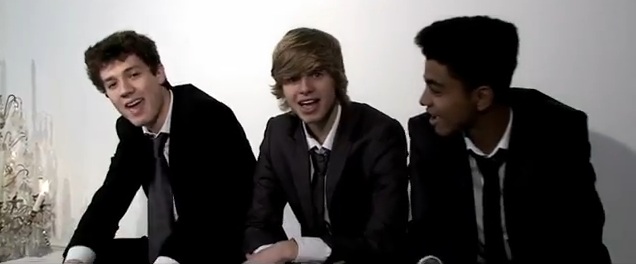

'A-ha!' - Imogen Heap:
'Just Got Paid' - The Fix:
Thursday, 13 September 2012


Theories 2: Carol Vernallis
"In video, our attention to the song shapes the way we perceive the image, but to an equal extent, what we attend to in the image helps to determine how we hear the music."
Vernallis believed that the camerawork, editing, and the star, would work against each other, but in someway, they can also compliment each other, as the way we feel for one will determine how we feel for the other.
Monday, 10 September 2012
Theories 1: Bordwell and Thompson
Bordwell and Thompson's main focus is the technique of continuity editing. They identified four different relations between how shots can link together in editing: Spatial, Temporal, Graphic, and also Rhythmic.
Spatial:
This type of editing concentrates on the setting and positioning of everything in the shot; this editing creates a sense of space. Spatial editing produces continuity editing by using an extreme long shot for an establishing shot, which is then followed by smaller range shots, such as mid-shots and close-ups. An example of this in a music video can be seen below in the video for 'Turn Around' - Conor Maynard:


Temporal:
This type of editing concerns type of action, and it contributes to the plots story time: order, duration, and frequency. The order of shots shown in a music video can be manipulated by the use of flashbacks and flashforwards, which are included to increase knowledge of the story, as well as prompting questions. An example of temporal editing with the use of flashbacks is seen in 'The One That Got Away' - Katy Perry, three of the incorporated flashbacks can be seen below:
Temporal editing also uses ellipsis - which cuts out the action of the video we do not need to see, as it is not important to the plot of the video. An example of this is seen in 'You Bring Me Joy' - Amelia Lily; one shot is the females in a car, then the next is of them at the beach - their journey there has been cut out as it is not significant to the story:

 As well as this, temporal editing also uses empty frames: where the figure of interest walks out of the frame, then cuts to an empty frame with the same figure walking into the shot. The frequency of events in continuity editing are often only shown once, and any repetition of shots are used to build tension, expectation, and anticipation. An empty frame is seen in 'We Are Never Ever Getting Back Together' - Taylor Swift:
Graphic:
This type of editing makes the video visual, so the transitions between shots are linked graphically; they are linked by similarity - whether it be by their shape, colour etc. Consequently, this creates smooth continuity editing. As well as a graphic match, graphic continuity: where the figure of interest is contrast throughout cuts, maintaining lighting level, and avoiding colour clashes, and graphic discontinuity: where colour and footage, or shape of focus figures contrast. Examples of this can be seen in 'Hall of Fame' - The Script:
Rhythmic:
This type of editing is when the cut to a different shot occurs in time with the beat of the music. It concentrates on the duration of shots; the length of each one is in relation to the beat and tempo. As a result, short shots will accelerate the tempo, while longer shots generate time for audience reflection. Cuts to the beat of the music can be seen in the chorus of 'Anything Could Happen' - Ellie Goulding:
Spatial:
This type of editing concentrates on the setting and positioning of everything in the shot; this editing creates a sense of space. Spatial editing produces continuity editing by using an extreme long shot for an establishing shot, which is then followed by smaller range shots, such as mid-shots and close-ups. An example of this in a music video can be seen below in the video for 'Turn Around' - Conor Maynard:


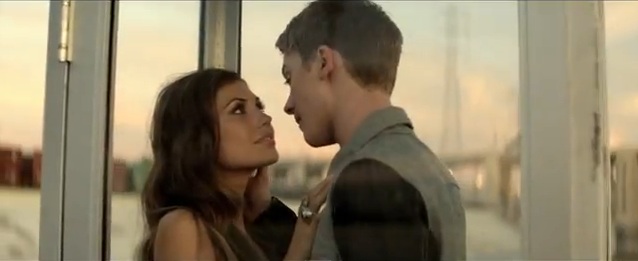
Temporal:
This type of editing concerns type of action, and it contributes to the plots story time: order, duration, and frequency. The order of shots shown in a music video can be manipulated by the use of flashbacks and flashforwards, which are included to increase knowledge of the story, as well as prompting questions. An example of temporal editing with the use of flashbacks is seen in 'The One That Got Away' - Katy Perry, three of the incorporated flashbacks can be seen below:
Temporal editing also uses ellipsis - which cuts out the action of the video we do not need to see, as it is not important to the plot of the video. An example of this is seen in 'You Bring Me Joy' - Amelia Lily; one shot is the females in a car, then the next is of them at the beach - their journey there has been cut out as it is not significant to the story:


Graphic:
This type of editing makes the video visual, so the transitions between shots are linked graphically; they are linked by similarity - whether it be by their shape, colour etc. Consequently, this creates smooth continuity editing. As well as a graphic match, graphic continuity: where the figure of interest is contrast throughout cuts, maintaining lighting level, and avoiding colour clashes, and graphic discontinuity: where colour and footage, or shape of focus figures contrast. Examples of this can be seen in 'Hall of Fame' - The Script:
Rhythmic:
This type of editing is when the cut to a different shot occurs in time with the beat of the music. It concentrates on the duration of shots; the length of each one is in relation to the beat and tempo. As a result, short shots will accelerate the tempo, while longer shots generate time for audience reflection. Cuts to the beat of the music can be seen in the chorus of 'Anything Could Happen' - Ellie Goulding:
Monday, 3 September 2012
Conventions Of A Music Video
With comparions between two different songs from different genres, the conventions of a music video include:
- A narrative behind the music and its lyrics, to give audiences a story to follow - keeping them intrigued.
- Suitable locations that fit with the mood of the song.


- Different shot types, primarily close-ups and mid-shots, in order to emphasise performance and lip-syncing to audiences.


- Shots that show band members on their own, then shots that show the band together - creating a sense of individuality, as well as unity between the band.


- The lighting has to be appropriate to the mood of the song, in order to generate the right atmosphere over audiences.


- Suitable props/costumes that are appropriate to the story that is being told.


- The pace of editing usually matches the tempo of the music.
- CGI and other effects are edited in to add creativity, and can be used to signify something important.

- Colours seen within the video have to fit with the genre of music.


- Actions or a dance sequence are usually seen according to the genre, to make the video more entertaining.


'The Man Who Can't Be Moved' - The Script:
- A narrative behind the music and its lyrics, to give audiences a story to follow - keeping them intrigued.
- Suitable locations that fit with the mood of the song.

- Different shot types, primarily close-ups and mid-shots, in order to emphasise performance and lip-syncing to audiences.


- Shots that show band members on their own, then shots that show the band together - creating a sense of individuality, as well as unity between the band.


- The lighting has to be appropriate to the mood of the song, in order to generate the right atmosphere over audiences.


- Suitable props/costumes that are appropriate to the story that is being told.


- The pace of editing usually matches the tempo of the music.
- CGI and other effects are edited in to add creativity, and can be used to signify something important.

- Colours seen within the video have to fit with the genre of music.


- Actions or a dance sequence are usually seen according to the genre, to make the video more entertaining.


Within Little Mix's music video, the colours used are bright and lively, while the high-key lighting generates a positive, happy atomshpere - with therefore matches the mood of the song. The locations are also very colourful, which adds to the up-beat nature of the song. The costumes worn by the band-members are fashionable and quite quirky, consequently, this appeals to the young generation the band are targeting. The video includes various shot-types, from close-ups to long shots, which allows audiences to see band-members on their own lip-syncing, then with the rest of the band dancing. A dance routine is incorporated to support the liveliness and energetic tone of the song.
However, in The Script's music video, the casual clothing creates a relaxed feel to the video - which is matched by the slow pace editing. The dull colours allow a sentimental and calm atmosphere, while the low-key lighting reinforces this. Different shot-types are used, allowing viewers to follow the lip-syncing, as well as the narrative being told. The primary location appears quite busy - this has been used to help with the narrative of the story.
'Wings' - Little Mix:
'The Man Who Can't Be Moved' - The Script:
Subscribe to:
Posts (Atom)